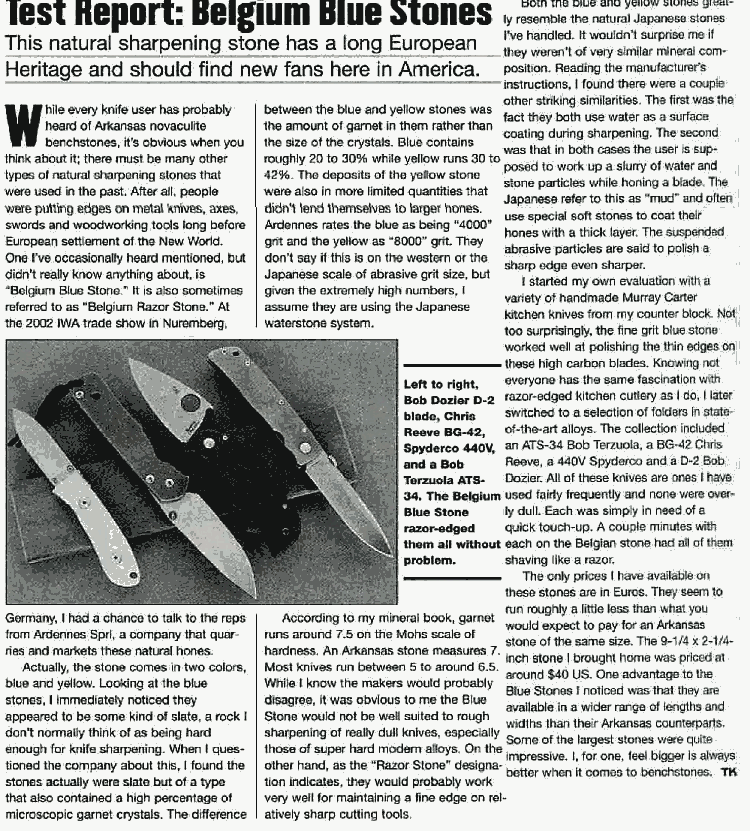
Belgian Hone™ Blue and Yellow Sharpening Stones
 On this page:
- About the Belgian Hone™ sharpening stone
- How they work - garnet crystals
- The two grades of sharpening stone - Yellow Coticule and Belgian Blue
- Combination Belgian Blue / Carborundum stones
- How to use the Belgian Hone™ whetstone
- History and Geology of the Belgian Hone™ Whetstone
- Video of the mining and processing of the Belgian Hone™
- Review of "Belgium Blue Stones" from Tactical Knives
- Printer-friendly information sheet
- PRODUCTS AVAILABLE
About the Belgian Hone™ sharpening stone
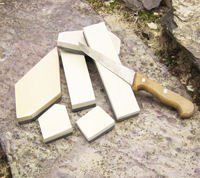
 Rediscover "Coticule", our Yellow garnet sharpening stone, the legendary, natural sharpening stone known since Roman times, exported in the past to USA by the train-load, now painstakingly newly quarried and fabricated in the Ardennes Region of Belgium.
Join the legions of users, who treasure this stone: wood workers, straight edge razor shavers, violin and surgical instrument makers, and many others.
You may not believe it until you see it!!! Amazing combination of speed and fineness of cutting. Leaving no discernible burr, or wire-edge! The remarkable cutting abilities of the stones are due to their embedded hard, rhomboid-shaped garnet crystals, millions of them, which both cut and hone, wedging, rolling underneath the steel. Cutting and polishing at the same stroke.
So durable are these stones that you may pass them on to your grandchildren.
There are two types of Belgian sharpening stone: the newly discovered "Belgian Blue" is equivalent to 4-6000 grit and the famous "Yellow Coticule" to 8-10000 grit.
Just add droplets of water to the surface and go: creating a slurry, keeping it whetted and be amazed.
Belgian whetstones can sharpen any kind of steel, including stainless steel and high speed steel (HSS), such as knives, chisels, scissors, axes, adzes, draw knives and more.
Unlike man-made or Japanese water stones, requiring lots of grit values (and continued maintenance of the stone), one Belgian stone alone can maintain your edge.
We LOVE these stones. You will too.
How they work - garnet crystals
 The stones contain a large percentage of garnet crystals. Garnet is only third in hardness behind diamond and corundum (ruby and sapphire), giving these stones their fast cutting action. The soccer-ball faceted shape of the garnet crystals provides an ideal cutting angle. The crystals cut lightly into the metal, producing very fine shavings. The garnet crystals are only 10-15 microns in diameter, and penetrate about 2-3 microns into the metal. The crystals' edges cut lightly into the metal, producing very fine shavings, while the following flat facets cut the resulting burrs (wire edges), effecting the polish or hone. All in one stroke!
The stone is non-porous and is used with water only.
Two grades of sharpening stone
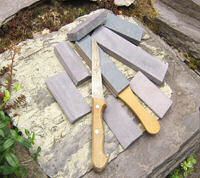
 The blue whetstone, 20-30% garnet by weight, is available in many sizes, even large bench stone sizes, and produces a 4000 grit polish.
SEE OUR BELGIAN BLUE WHETSTONES
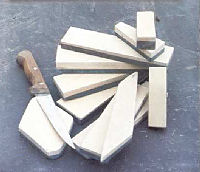 The yellow sharpening stone, "Ardennes Coticule", is available only in small thin layers, and therefore is glued to a slate base. It is often odd-shaped to make use of all the pieces. The yellow coticule contains about 30-42% garnets of about 10 microns in diameter, for an 8000 grit polish. There has never been a better sharpening stone. You will own it for life.
SEE OUR YELLOW COTICULE WHETSTONES
If you need an even finer hone, check out our Escher sharpening stones from Thuringia in Germany.
Combination Belgian Blue with Carborundum (Silicon Carbide)
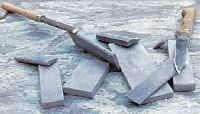
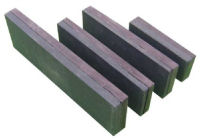 Belgian Blue whetstone (4000 grit) bonded to synthetic Carborundum with 600 grit. Use the Carborundum side to do the hard work of restoring a blunted edge and the Belgian Blue side to do the real sharpening and final honing.
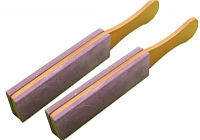 The combination stone is also available in a "kitchen" version with a wooden handle — excellent for sharpening knives.
SEE OUR COMBINATION BELGIAN BLUE/CORBORUNDUM WHETSTONES
Prices
The stones in shown in our store are only some of those available. We have a wide variety of other shapes and sizes of these stones. If you have special applications, we can custom size many of our stones. Please phone us at 1-800-350-8176 with your requirements.
How to use the Belgian Hone™ whetstone
Unlike currently popular water stones, the Belgian stone is surface wetted, never soaked in water. The stone quickly creates its own slurry, releasing garnets, cutting and honing in the same stroke. To create a long lasting sharp edge, simply use any of your already successful techniques or follow the method shown.
Curved cutting edges
 Place the stone on a flat surface. Move the blade obliquely on the stone in the usual "cutting" direction, at the correct angle. Whet the faces of knives, lancets etc. alternately.
Straight cutting edges
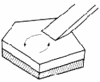 Use any technique that is successful for you, or:
Place the stone on a flat surface. Move the blade in circles on the stone at the correct angle, pushing harder in the "cutting" direction.
History and Geology of the Belgian Hone ™ Whetstone
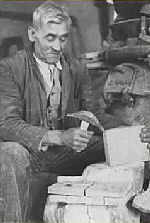 The stones are quarried from 480 million-year-old grey/yellow/pink sedimentary rock which has metamorphosed from clay and volcanic ash and now contains garnet crystals. It is non-porous.
Known and mined since the days of the Romans, the source of the Belgian Coticule yellow whetstone, or Stone of Vielsalm, was long thought to have been exhausted and was shut down for 50 years.
Recently, a new high quality whetstone was discovered with identical sharpening properties as the yellow, but it was blue in color because of iron oxide in the sediment. By mining for "Blue" stone, a small quantity of "Yellow" now became available, from industrial to surgical quality.
See a video about the mining and cutting of these exceptional stones:
Products